Q-switching vs. Mode-locking
Q-switching and mode-locking are two of the most widely used techniques for generating short optical pulses. While both approaches produce pulsed laser output, they are based on fundamentally different physical principles and are optimized for different performance characteristics. Q-switched lasers are designed to generate energetic pulses with high peak power, whereas mode-locked lasers produce ultrashort pulses with durations extending into the femtosecond regime. As a result, the choice between the two technologies depends largely on the required pulse duration, pulse energy, repetition rate and system architecture.
Mode-locking
Mode-locking is a technique for generating ultrashort laser pulses by establishing a fixed phase relationship between multiple longitudinal modes of the laser cavity.
As these modes interfere constructively, they form a train of extremely short optical pulses that continuously circulate within the resonator.
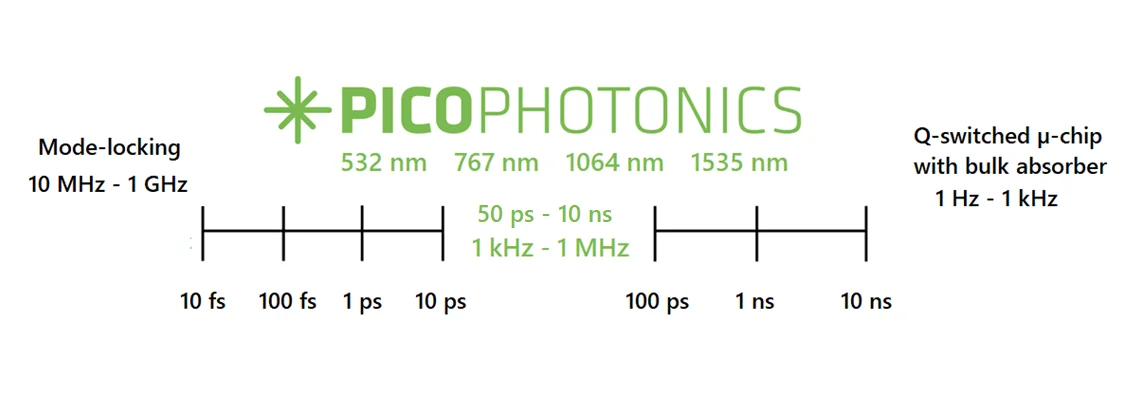
Mode-locked lasers are capable of generating pulse durations from several picoseconds down to a few femtoseconds, making them the preferred choice for applications requiring extremely short interaction times or minimal thermal loading of the target material.
Typical repetition rates though range from tens of megahertz to several gigahertz.
The very short pulse durations are accompanied by relatively broad optical spectrum and inherently high repetition rates.
In applications requiring lower pulse frequencies or narrow spectral linewidths, additional components such as pulse pickers or spectral filtering stages may therefore be required.
Q-switching
Q-switching generates laser pulses by temporarily storing energy within the laser gain medium and then releasing it in a rapid burst.
This process produces short pulses with high pulse energy and high peak power while maintaining relatively low repetition rates.
Depending on the laser architecture and switching mechanism employed, pulse durations typically range from several nanoseconds down to the picosecond regime.
Compared with mode-locked lasers, Q-switched systems generally provide significantly higher pulse energies in a simpler, more compact design, making them well suited for applications such as spectroscopy, biomedical imaging, precision sensing and analytical instrumentation.
Picophotonics: built on passive Q-switching
Picophotonics' proprietary SESAM-based microchip laser technology builds upon the advantages of Q-switching to generate highly stable picosecond pulses within a compact architecture. This combination makes it particularly well suited for demanding OEM systems and cost-effective table-top devices, where performance, reliability and ease of integration are equally important.
Passive or Active Q-switching Show Products
Typical Applications
Mode-locked lasers are widely used in applications where extremely short pulse durations are essential.
Their ability to minimize thermal effects makes them particularly attractive for ophthalmic surgery, precision micromachining, semiconductor processing and advanced scientific research.
Q-switched lasers, on the other hand, are commonly employed in spectroscopy, analytical instrumentation, rangefinding, marking, biomedical imaging and industrial sensing,
where higher pulse energies, compact system design and excellent operational stability are often more important than achieving the shortest possible pulse duration.
Which technology is better?
Neither Q-switching nor mode-locking is inherently superior—the optimum choice depends entirely on the application.
Mode-locked lasers provide the shortest pulse durations available and are the preferred solution for applications where ultrafast light-matter interaction and minimal thermal effects are critical.
For this reason, they are widely used in fields such as ophthalmology, precision micromachining and ultrafast spectroscopy.
Q-switched lasers offer a different balance of performance by combining short pulses with higher pulse energies, lower system complexity and excellent operational robustness.
These characteristics make them particularly attractive for analytical instrumentation, Raman spectroscopy, biomedical imaging and precision sensing applications.
| Parameter | Q-switched lasers | Mode-locked lasers |
|---|---|---|
| Typical pulse duration | Several ns down to sub-100 ps (SESAM-based) | Several ps down to a few fs |
| Pulse energy | High (µJ to mJ) | Low to moderate (typially nJ) |
| Typical repetition rate | Single-shot up to hundreds of kHz | Tens of MHz to several GHz |
| System complexity & size | Low — compact, few components | Higher — precise cavity dispersion control required |
| Typical applications | Spectroscopy, rangefinding, biomedical imaging, sensing | Micromachining, ophthalmic surgery, ultrafast spectroscopy |