Key Properties

Short pulses

Delivers picosecond pulses down to 50 ps. Standard pulse durations: 50 ps, 100 ps, 200 ps with custom engineering available, extendable to a single-frequency nanosecond configuration (up to 1 ns) where required. Ensures high temporal precision and minimal thermal load. ~10% difference in pulse duration between 532 nm and 1064 nm.

Dual-wavelength emission

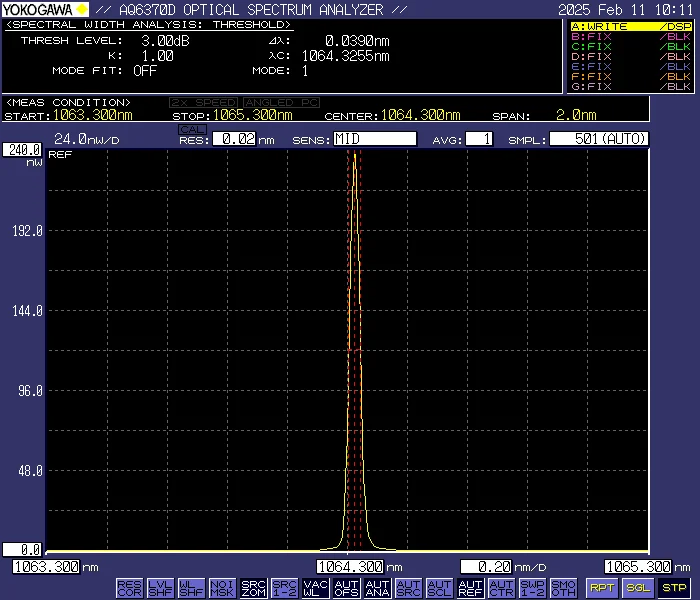
Stable, single-frequency emission at 532.2 nm and 1064.4 nm. Matched timing for both wavelengths with external trigger available.

High peak power

Pulse energies up to 3 µJ and >40 kW peak power at 532 nm and up to 5 µJ and > 50 kW at 1064 nm. Smooth electronic power control with options for wavelength independent power tuning.

Single-frequency spectrum

Stable, single-frequency spectrum with < 0.06 nm linewidth at both wavelengths. Provides excellent spectral stability and mode-hop free emission. Central frequency can be factory set according to preference.

Pulse triggering

Integrated control electronics with low-jitter optical trigger-out for precise output pulse timing. Optional TTL trigger-in available for active pulse control.


Beam Properties

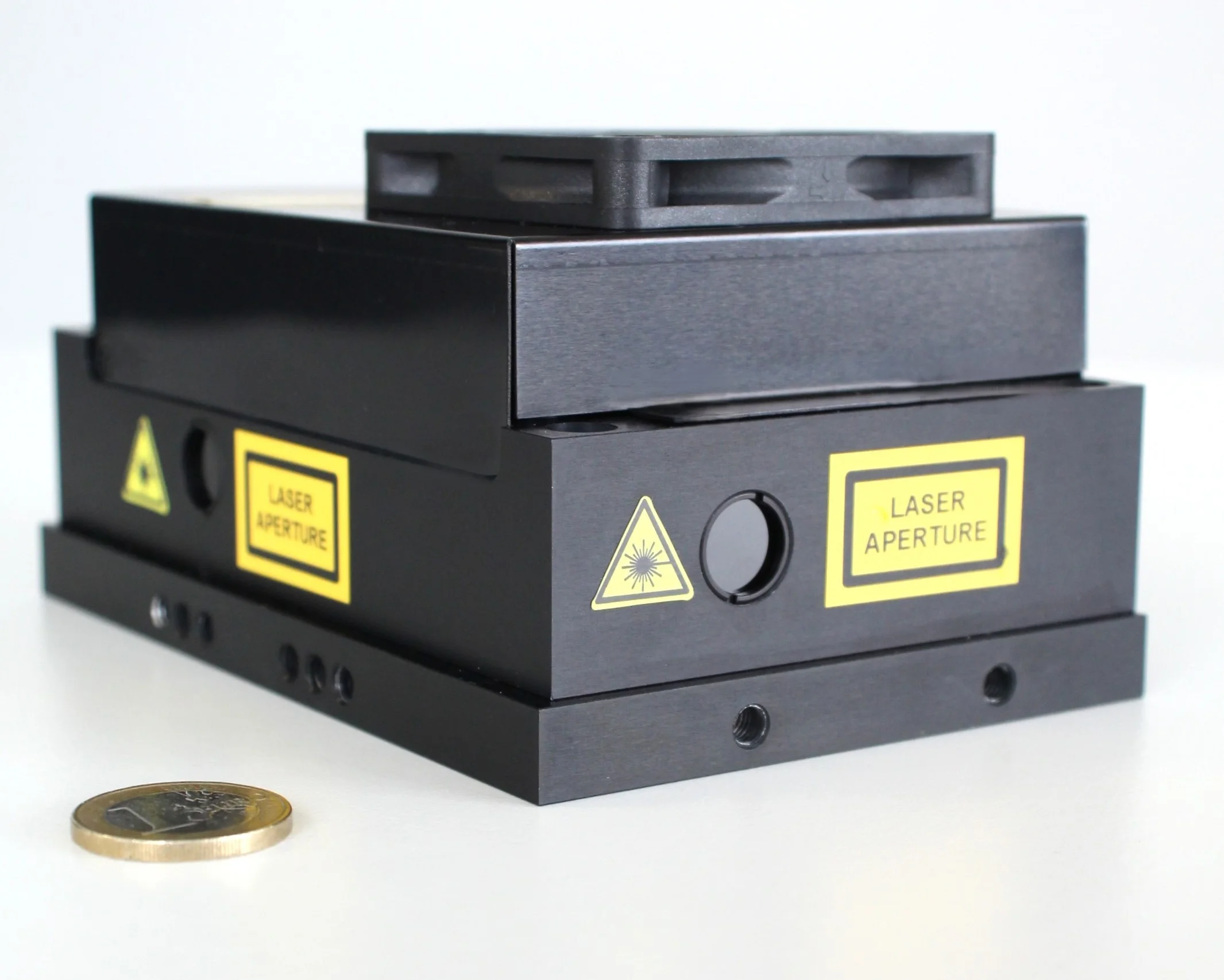
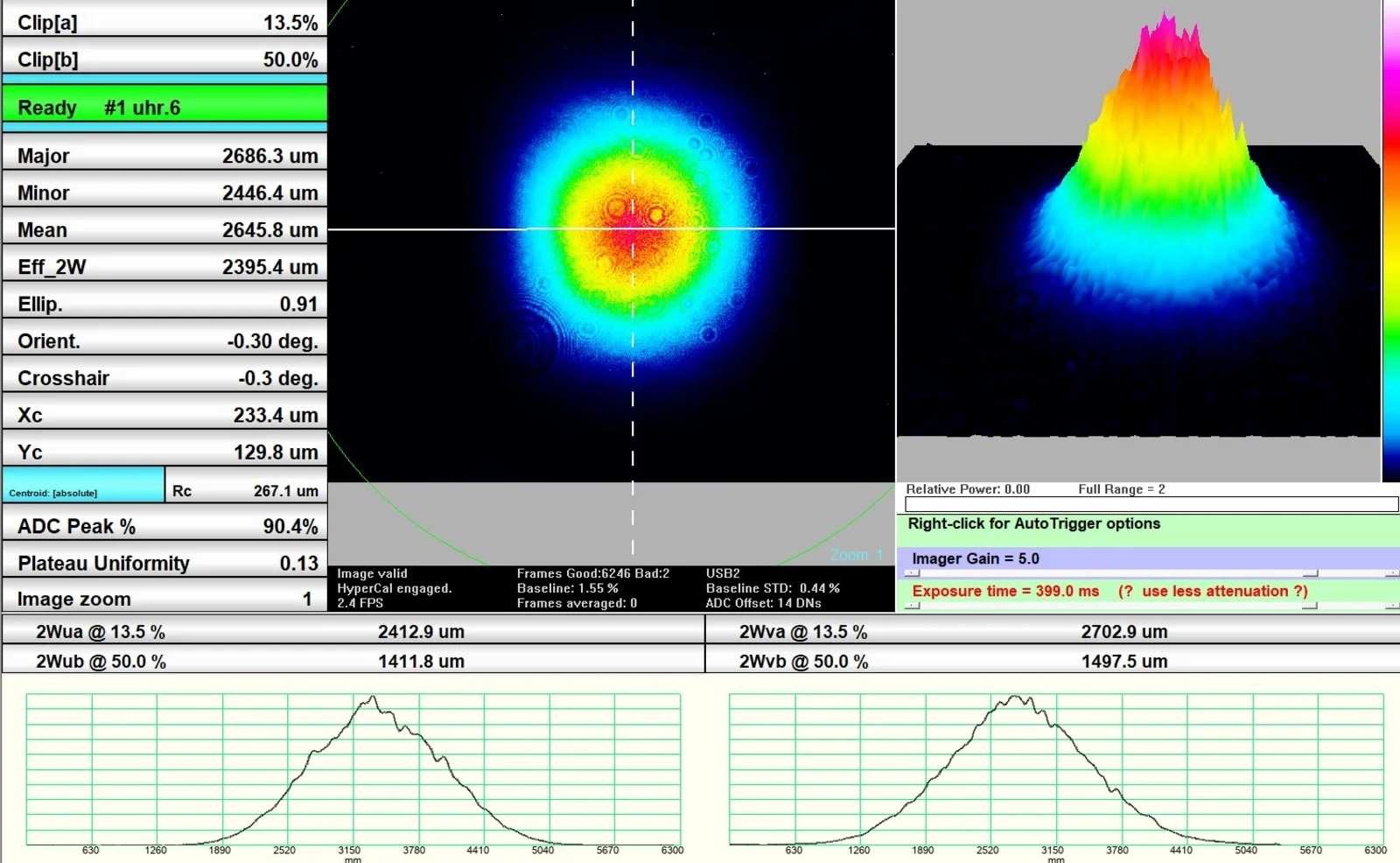
Stable output with M² < 1.3, available in free-space or fiber-coupled formats. Supports precise focusing and long-distance propagation.


Technical Specifications Dimensions and Interfaces
Photoacoustic Microscopy Back to Products

Key Use Cases for Synchronized Dual-Wavelength Output

CP2L's built-in, synchronized 532 nm and 1064 nm pulses — with matched timing and external trigger control — open up experiments that a single-wavelength source can't support on its own.

Pump-probe & time-resolved measurements

Use one wavelength to excite a sample and the other, precisely delayed, to probe the resulting change — well suited to nanosecond-scale kinetics, intermediate-state lifetimes, and other slower photoinduced dynamics. Note: temporal resolution is set by pulse duration (50–200 ps).

Two-color time-gated Raman & fluorescence multiplexing

Pairing 532 nm excitation with a synchronized 1064 nm channel lets instrument builders combine strong visible-wavelength Raman efficiency with an NIR reference or fluorescence-discrimination channel in a single, timing-matched system. See our Time-Resolved Raman Spectroscopy application page for more information.

Synchronized dual-wavelength sensing

Differential, two-wavelength techniques — such as ratiometric or differential-absorption sensing — use a synchronized on/off-target wavelength pair to cancel common-mode noise and isolate a target signal, improving measurement robustness in the field.

Nonlinear & frequency-conversion research

The dual-color output can also serve as a starting point for nonlinear-optics experiments and custom frequency-conversion setups, enabling generation of UV bandwidths as well as extended white-light ranges.

Request Quotation

Wavelength, pulse duration (from 50 ps), pulse energy and repetition rate are configurable to your requirements — whether that’s a single research unit or integration into a product. Tell us what you need.

We reply within one business day.